


What are the advantages and disadvantages of the method of driving and pressing reinforced concrete piles?
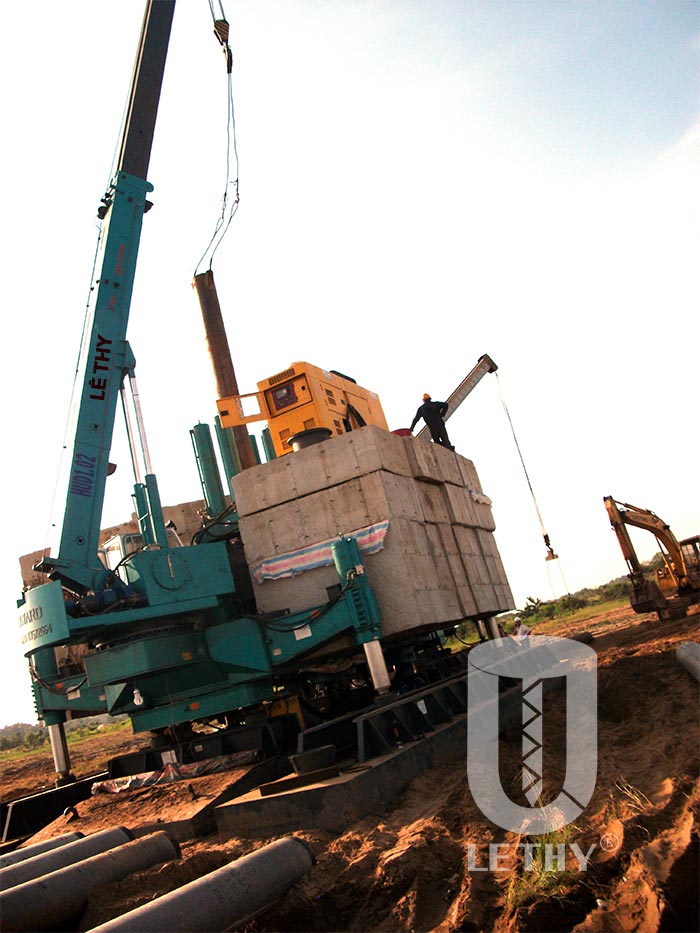
DUL concrete piles in the form of PC spun piles (rarely use the word centrifugal) are often found in Japan or Korea. They are not common in Europe. In Europe, DUL square and triangle piles are used.
In our country today, some factories (Phan Vu, BT620, BCC, Phu My) can manufacture both types of piles and are commercializing both types, but mainly round piles are still used.
+ The cost advantage compared to RC piles is not very significant, because concrete is more expensive (high grade), and PC bar reinforcement (with strength fy = 14000 – 16000 kg/cm2) must be imported from Indonesia, Thailand, Malaysia, or Korea/Japan, costing more than double and requiring stockpiling due to limited control over timing.
+ Its outstanding advantage is progress. If casting regular piles or UDL square piles, the accelerated curing technique cannot be applied. After steaming for about 2-3 hours, it has hardened (reached the mark) so it can be immediately transported to the construction site the next day.
+ There are two types of PS spun piles: PC and PHC, PC piles include steam curing at normal pressure (with t=70-80oC), and concrete uses common additives (in Vietnam). are Sikament R4, Sikament FF when needed), PC40 cement (ATSM C150 type I) cement grade is only 400 kg/cm2) but thanks to centrifugal compaction, after heat curing it can easily reach 700kg/cm2 .
But to further improve, people use PHC piles, which are exactly the same as PC piles, except for the heat curing step. People use heat + pressure curing by putting them in the autoclave to get a large batch of piles in just one hour. , put it in the car and go to the construction site.
But this method is too costly to invest in the autoclave, Vietnam cannot afford it (it increases the cost), but we only use silicafume-based additives to speed up the process of early strength increase when heat curing at normal pressure. (using the same PC pile production equipment system as before), but spending money to buy additives that the investor does not require urgent progress (like the Western style) is not worth it because it increases the price. Therefore, only PC piles are currently popular.
Thanks to the centrifugal rotation technique (spinning), the concrete layer spreads into shells on both sides that are just hard enough (average shell wall thickness is 50-70cm depending on pile diameter. This helps save materials (transfer materials, light pile driving). softer).
Reinforcing steel is formed into a cage and placed in a mold. After centrifugal spinning, it sits in the middle of the concrete wall and contributes to load bearing (tightening the concrete). The key to making the steel cage is to cut the steel precisely, with an error margin of 1mm/15mm. Then, the two ends of the steel wire are pressed tightly together while a high-intensity current (low voltage) is passed through to create a knot-like structure at each end (this is called the heading process).
A pile usually has 8-16 steel bars (depending on design). The main steel and stirrup steel are put through a caging machine to create steel. Put the ***g into the mold, use the flange (also the piece to connect the pile head later) to make a place to lock the steel bar, then use a hydraulic jack to stretch the steel bar, anchoring the flange to the mold (requires the mold to be sufficient). tension-bearing capacity of steel bars (70-120 tons).
After the concrete reaches its strength (right after leaving the curing tank), the mold is released, which means letting the tension of the steel bar that is applied to the mold be transferred to the concrete (stress inducement). After this process, the piles can be immediately transported to the construction site.
Compression capacity of the pile: a little larger than regular concrete piles, the reason is that the concrete grade is much higher than regular piles, so even if the amount of pre-compressive stress caused by the steel bar is subtracted, it is still large. . But the important thing is that the bending moment is very high. This is more important for piles if we want to have long piles to reduce joints, and want to have light piles for easy construction. .
The forte of this pile is to drive in weak areas, requiring long piles, but when driving on sandy soil, the bearing capacity is still better than regular piles, but it cannot promote its advantages compared to regular piles so it is rarely used ( uneconomical).
Piles are usually 12m long, rarely 15m long, mainly due to transportation and pile driving conditions, not at all due to production techniques. Diameter is usually 500-600-900mm.
The bearing capacity of this pile is the same as that of conventional RC piles, mainly controlled by ground conditions, not exceeding the strength threshold due to the material.
The length of a D300-400 pile is about 8-10m, a D500-600 pile is about 12-15m, D900-D1200 piles can be made for marine construction. When connecting two pile segments together, use weld to weld the two pile flanges together. The total pile length is usually about 45-60m, this is determined by geological conditions.
Currently, Vietnam has not issued standards for PC piles, so manufacturers have to search for projects mainly designed by foreign countries. And because there are no standards, our design engineers are also afraid to incorporate it into the project; Safety is also a difficult problem for this type of pile entering the construction industry. And not only pre-stressed pile technology but many other technologies will also suffer from our Vietnamese style of promulgating standards.
In addition (in the South), centrifugal electric poles have also been converted to be manufactured using this method, no longer using PC as before.
Let me add a few more things about construction in Vietnam, but not in the "technical" sense.
+ Regarding additives in Vietnam, Sika is still the most popular, not because Sika is better than MBT, but because the name is easier for Vietnamese people to pronounce, especially workers and small contractors – a large number of engineers without expertise in building materials (structural engineers, etc.) also call the additive Sika (just like Vietnamese people call motorcycles "Honda").
Do you see it or not, but the Holcim cement guy is doing very expensive name change campaigns to give it a name for globalization. Previously, when they entered Vietnam (1994), they entered into a joint venture with Vietnam Cement Corporation (In Vietnam, cement is still a monopoly, the price of cement is 2.5 times more expensive than in Thailand), they chose a very good name: Sao Mai Cement (Morning Star), as a result, part of their retail market share was lost to someone else. However, overall, they have their own reasons for choosing that way.
Nowadays, Vietnam has a few "unusual" cement brands from some construction companies that invest in cement production; they buy clinker from Thailand (mainly from Siemcement) to grind and sell, competing with the "big players" quite well, mainly thanks to connections and timing when the construction market demand slightly exceeds supply.
However, construction companies (as well as other domestic businesses in other sectors) have a kind of "civilized" business practice of owing each other money and tying up each other's capital for as long as possible, even if the contract stipulates "payment within one month after acceptance." This culture significantly slows down production, but it has become chronic, unlike the clear-cut practices of foreign companies in Vietnam.
Sika entered Vietnam in 1993, before MBT, their market share is currently larger than MBT. There are a few types of additives in the country but they only live in each related project, without enough potential for development.
Those "sewage-water" additives are being sold at exorbitant prices. In the past, our concrete plant bought raw chemicals from abroad and mixed them ourselves to create additives equivalent to Sika's (Sikament R4, NN). They were cheaper, but we only used them for our own concrete plant to create a small competitive advantage over other concrete plants.
Trying the same criteria as Sika, even at a large thermal power plant, it has surpassed the competition with Sika, but if you mix it manually, large production is not suitable.
Generally, concrete is a mixture of stone and sand. The cement particles only serve to bind and position the stone and sand. Additives reduce friction, helping the particles to be more tightly packed, resulting in a higher strength grade (adding water to reduce friction will lower the strength grade). Silica fume, being a "fume," is very fine and has a greater compacting effect, resulting in a higher strength grade.
+ Regarding pre-stressed concrete, in Vietnam there is a French company that has entered into a joint venture with Vinaconex to set up a factory in the north to produce small beam components and prefabricated floors, but due to the inherent limitations of prefabricated concrete, The factory's production cannot develop.
As for piles (reinforced concrete or reinforced concrete) cast at the factory, they are more advantageous than floor columns but are not the solution that contractors choose for their pile foundations or buildings at the construction site.
– In terms of manufacturing costs, the slight advantage of prestressed concrete piles over reinforced concrete piles is negligible in terms of steel savings, but the depreciation of machinery increases, so the overall benefit is minimal.
– Furthermore, design engineers often don't include prestressed concrete piles in their designs during the design phase, so the contractor can't change or suggest using a different type of pile (hehe... just adjusting the length of individual pile sections while maintaining the total pile length is already complicated enough, let alone changing the entire pile design...).
– Another major issue I noticed you mentioned is the transportation infrastructure. It's true, it can't handle the transport of heavy materials like reinforced concrete on the roads, and therefore the cost of bribes (money given to traffic police to let us pass) is very high. Construction contractors prefer to cast their own reinforced concrete piles on-site.
– The VAT rate for piles manufactured at the factory is also 10%, whereas it should only be 5% to be comparable with factories producing other products. This does not encourage the construction industry to "industrialize" production.
Another issue that is particularly important to note in prestressed concrete compared to reinforced concrete is its "inductance," which means its design process must take into account the sudden loss of stress, leading to the need for additional reinforcing steel and increasing production costs.
Excessive brittleness is very dangerous, for example, if an electric pole is accidentally hit by a vehicle, it will only bend and break, but the steel reinforcement will still bear the force so that the wire does not fall on the spot, but if If it is a BTDUL column, the column seems to have been cut by a knife, the entire top of the column collapsed on the spot and the consequences of the 220V current are needless to say.
A reinforced concrete floor will usually sag slowly before collapsing while the same thing does not happen with a reinforced concrete floor. It is recommended to calculate the safety factor for reinforced concrete structures to satisfy these conditions.
Contact information:
- Address: No. 12, Street 27, Van Phuc Urban Area, Hiep Binh Phuoc Ward, Thu Duc City, HCMC
- Phone number: 0915.611.337 Mr. Phuong or 0915.411.337 Mr. Quan
- Email: [email protected] or [email protected]
- Website: Lethycorp.com
- Road Map: See

 Vietnamese
  English
  Chinese