


Construction organization and construction methods for the basement using the Larsen pile diaphragm wall and support frame system
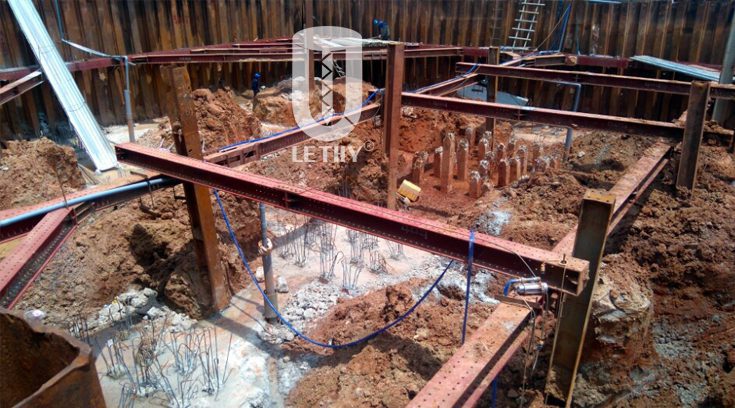
Shoring bracing system at University of Fine Arts
I.General introduction basement construction
1.1. Content :
- Transporting basement soil
- Transportation methods are based on terrain conditions, construction sites, traffic, etc.
1.2. Construction scale and structural characteristics
- Construction site area:
- Construction area :
- Construction length, width
- Reinforce the foundation with bored piles.
- Pile connection structure with foundation plate, tie beam and reinforced concrete floor
- The basement is surrounded by a retaining wall made of concrete piles. .
II. Organize construction sites.
2.1 General part:
- Construction organization design complies with the requirements of the bidding documents.
- Based on design drawings and other technical documents of the bidding documents.
- Based on the construction progress requirements of the bidding package.
- Based on the Contractor's capacity to provide materials, equipment and human resources.
2.2. Some comments:
- According to the construction bidding documents, the technical solution proposed is to construct diaphragm walls, barrette piles, bored piles and basement construction using the semi topdown method.
- However, through the study of the project's topography, hydrogeology, and the impact of neighboring structures, flexible solutions will be developed, possibly using Larsen sheet piles, to ensure safety during construction.
- Larsen sheet pile diaphragm construction technology is considered a good solution for basement construction, offering fast construction times and the use of mostly machinery. In particular, the application of automated pile-driving robots makes the Larsen sheet pile diaphragm construction process faster and safer.
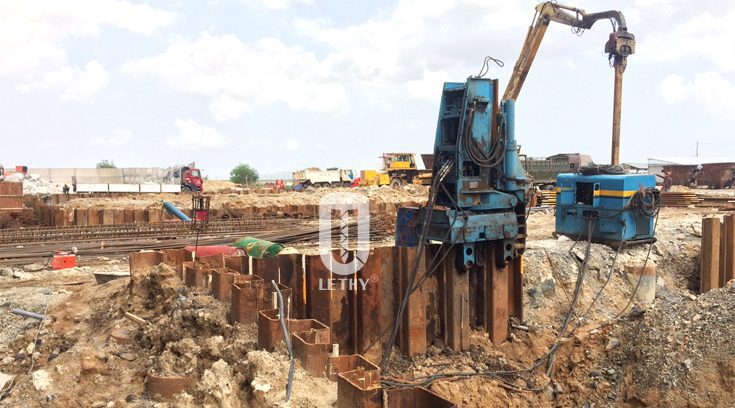
Larsen pile pressing robot
2.3.Proposed technical solution:
-Larsen piles are built to the design elevation so that the pile tip elevation is +0.5m compared to the natural elevation.
- Excavate the soil to a depth of -0.5m and proceed with the installation of the H-shaped steel retaining frame.
-Continue to install the Shoring-Kingpost anti-frame system.
- Excavate and transport the excavated soil to the construction elevation for the bottom sealing concrete layer.
-Can be constructed using the rolling method for large construction areas.
III. DETAILED CONSTRUCTION MEASURES
3.1. Comply with technical standards:
- Regulations on quality management of construction works TCVN Decree – 209/2004/NDSD-CP
-Basic principles for quality management of construction works TCVN 5637 – 1991
- Construction organization according to TCVN 5055 – 1985
-Tolerances in construction works – methods for measuring and inspecting construction works and prefabricated components of construction works at measurement points TC 210 – 1998
- Occupational safety standards system. Basic regulations TCVN 2287 – 1978
-Electrical safety in construction, general requirements TCVN 4086 – 1985
-General safety requirements for electric welding work are based on TCVN 3146 – 1986.
-Technical safety regulations for lifting equipment TCVN 4244 – 1986
-Technical safety regulations in construction TCVN 5308 – 1991
-Fire and explosion prevention for houses and structures TCVN 2622 – 1995
3.2. Site positioning and foundation excavation work:
3.2.1. Construction surveying work
- Surveying plays a crucial role in ensuring the accurate geometric shape and dimensions of construction projects, guaranteeing the verticality and inclination of structures, correctly determining the centerline of structures, components, and technical systems and pipelines, and minimizing construction errors. Surveying must comply with TCVN 3972-85.
- Positioning the project: After receiving the handover from Party A of the site, landmarks and elevation of the area. Based on the positioning plan drawing, take measurements by machine.
- Determine the location and elevation ± 0.000 of the construction items based on the total area of the area, then make a written confirmation with the Project Management Board on the basis that the designer is responsible for the technical solution. position technique, height ± 0.000. Locate the project within the land area according to the design.
- Establish a construction control network as a means for all survey work. Proceed to set monitoring markers for the project. These observations are intended to monitor the impact of the construction process on the deformation of the project itself.
- Monitoring landmarks and monitoring equipment must be strictly protected and managed, and use on the project must be approved by the investor. Measuring equipment must be calibrated and calibrated within the allowable period of use.
- The project must have at least 2 main marker piles, with the marker piles at least 3 meters away from the edge of the structure. When constructing, based on landmark piles, make detailed measurements of the house's positioning axes.
- Prepare records of monitoring milestones and regular monitoring reports for each stage of construction to monitor deformation and position deviations and promptly find solutions.
3.2.2. Lasen pile construction work
- Use Larsen piles to make a surrounding wall, then level the ground to create a level surface
This is for the pile construction project. After the piles and retaining walls are constructed, the piles will be removed and reused.
Preparation
a. Electricity supply:
Complete the installation of the 380V – 125KW power supply and temporary access roads for construction machinery and cranes.
b. Estimated construction time
- For pile pressing method using static machine, working time is from 6:00 a.m. to 11:00 p.m.
- For the pile driving method using a vibratory hammer, the working hours are from 7 am to 7 pm.
c.Construction organization
Method for pressing and withdrawing Larsen IV piles using static pressing method:
- Gather Larsen presses, cranes and pile materials to the construction site.
- Construction equipment includes:
- Specialized tire crane:
- Brand: Kato 25 tons
- Lifting Capacity: 25 tons.
- Country of manufacture: Japan
- Static pile driving machine: AVP-130
- Pile head driving force: 70 tons 130 tons
- Country of manufacture: Japan.
- Power supply: 380V – 50KW.
Construction:
-Use 1 to 2 hydraulic pile presses (with the above parameters) to construct the construction method drawing and the crane to serve pressing piles to move on the temporary road.
- Due to alternating construction work, we have to arrange it smoothly to avoid construction affecting each other, leading to slow progress.
- The verticality of Larsen piles has an error in the range of 0-1% and the pile tip tilts towards the outside of the building. The verticality of the pile during the pressing process is adjusted by machine, using a beam to determine the verticality of the pile.
- Sheet pile wall construction process:
Step 1: Press the first pile bar to the specified depth.
Step 2: Press the second pile bar and determine the load capacity of the pile.
Step 3: Raise the machine body and stop at the position of the pile clamp lower than the pile head.
Step 4: After stabilizing, raise the pile press machine.
Step 5: Push the hammer head pile clamp forward and rotate the clamp from right to left.
Step 6: Adjust the hammer head to the pile to drive the pile down slowly.
- Note that the pressing part must be carefully aligned so that the pile does not become skewed.
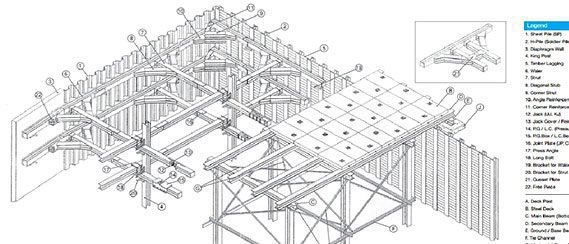
Larsen Shoring model
In case of deposit withdrawal:
- When withdrawing piles for pressing, then the location of the crane to serve the extraction will be discussed with the investor. If it is not possible to stand on the internal road and ring road, the investor must give permission. The construction party brought the crane down to the basement floor to serve the pile removal work.
- Our construction unit proposes: To facilitate pile removal, we suggest that the Investor excavate and construct the basement walls first, then remove the piles before proceeding with the basement floor slab construction. (This is to avoid the risk of the crane having to move onto the basement floor slab and causing damage.)
3.2.3. Excavation of foundation holes
- Dig a foundation hole with an excavator, then use a tower crane to scoop and load the soil onto a truck to transport it to the place where the Contractor has determined it is allowed to dump.
The Contractor plans to mobilize a sufficient number of workers and vehicles to transport the excavated soil so that there are no traffic jams. Wherever the volume of excavated soil is transported there, it will not affect the construction. next jobs. The contractor prepares the construction plan according to the following process: - Compacting the foundation soil, laying brick formwork, constructing beam and slab structures, elevation +0.000
- Excavating soil for basement 1 manually, combined with a tower crane to load soil onto transport trucks and dump it
- The basement floor slab at elevation +0.000 and the foundation slab (measuring slab) will be constructed sequentially from top to bottom (basement floor 1 walls supporting the floor beams will be constructed first, followed by the remaining walls), with accompanying drawings.
- Compacting the ground, building bricks and formwork, constructing the first floor beam structure and reinforcement
- Digging the basement soil manually, combined with a tower crane to load the soil onto a transport truck and dump it
- Pouring concrete for foundation lining, erecting formwork, constructing core foundation structure
- Fabrication and erection of formwork, erection of steel reinforcement and construction of basement floor beam structures in order from bottom to top.
- In this bidding package, our Contractor is very interested in the foundation pit water collection system. The Contractor's solution is that while constructing each basement floor, he must always create temporary sump pits. At the same time, there is someone on duty using a sufficient number of pumps to pump water into the area's general drainage system (drawings attached).
3.2.4. The work of completing, accepting and handing over the project complies with and applies:
- Technical standards for construction and acceptance
- Rules for construction and acceptance of soil work TCVN 447-1987
- Standard for acceptance testing of completed construction site surfaces TCVN 4516 – 1988
- Rules for construction and acceptance of completed works TCVN 5674 - 1992

Construction of basement with Larsen piles combined with Shoring kingpost system
Supply and construction of concrete pile driving DUL D500, D800, D1000...


 Vietnamese
  English
  Chinese